
Sections
From flat coil to finished run
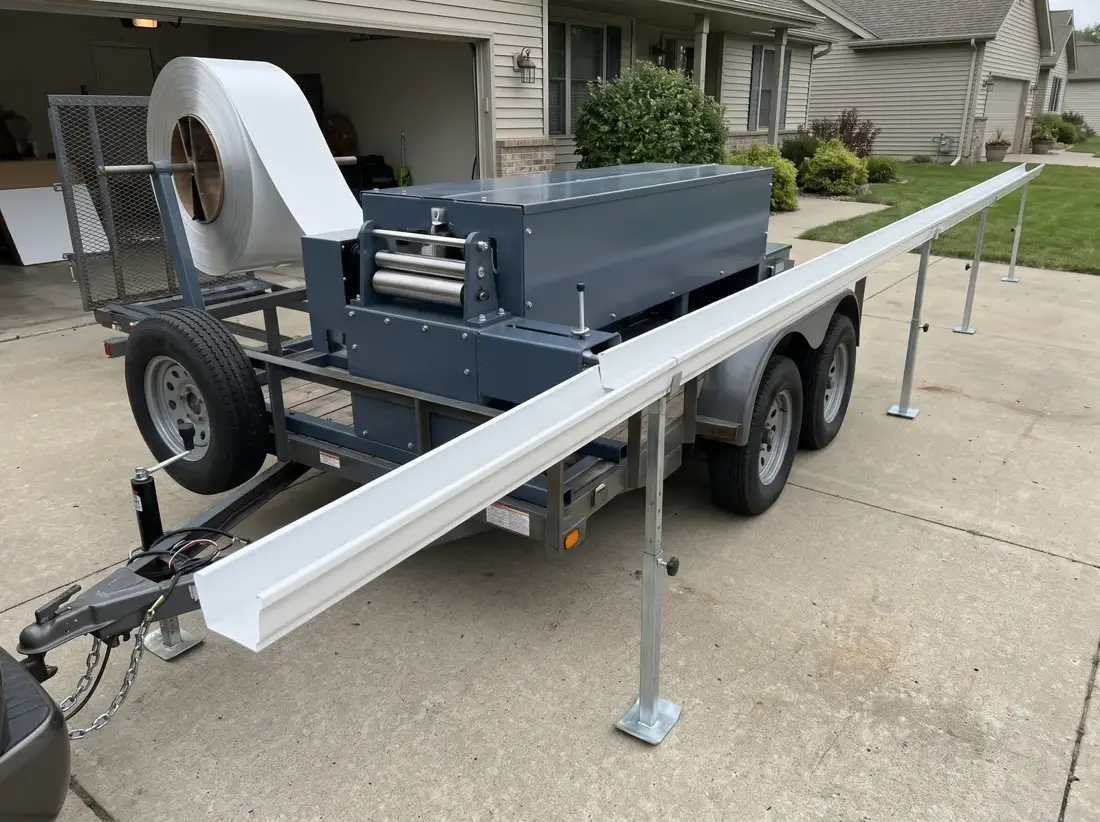
Painted aluminum arrives on a roll. The installer threads it through a forming machine on a trailer, which bends it into a K-style profile, and shears it off when it matches the eave. A 48-foot back wall gets a 48-foot gutter. Joins only happen where the house itself turns a corner, where a run ends, and where a downspout drops out.
| Feature | One-piece (seamless) | Pieced (sectional) |
|---|---|---|
| Splices on a straight wall | Zero | About one per 10 feet |
| Usual drip points | Miters, ends, drops | Miters, ends, drops and each splice |
| Where it is shaped | At your house | In a factory, in stock lengths |
| Typical material | Aluminum, occasionally steel or copper | Vinyl, aluminum, steel |
| Fitted by | A crew with a forming machine | A crew or a homeowner |
| From the street | One continuous line | Visible joins |
The order of work on the day
- Every eave is taped, along with each valley and the spots where leaders can go.
- Coil is fed through the machine and each length cut to suit.
- Drop holes are cut, outlets set in sealant and end caps riveted on while the run is still on sawhorses.
- Two or three people carry each length up and fix it with hidden hangers spaced near two feet, tilted gently toward the drops.
- Corners are mitered, riveted and sealed inside.
- Leaders are strapped on, then a hose goes into every run to prove the slope.
Why fewer joints pay off west of the Narrows
The city records about 37 inches of rain a year, with December the wettest month, and most of that falls as days of drizzle and steady rain from fall into spring. A splice that might weep briefly in a summer shower elsewhere can drip for a week here, and the board behind it never dries.
Debris adds to it. Fir needles and moss settle into a trough and hold water, so a loaded gutter flexes along its length. Splices are where that flex shows up first.
House size matters too. Plenty of two-level homes in Gig Harbor North, Canterwood and Wauna have rear eaves of 40 to 60 feet. Sectional gutter on a wall like that means five or six extra joins, each one sealed by hand and each one aging.
Finally, wind. When a winter gust gets under a gutter, a single length spreads the load across all its hangers; a string of joined pieces can twist at the joins.
Options you can order seamless
| Option | Typical availability | Worth knowing |
|---|---|---|
| Profile | K-style everywhere; half-round from a few shops | Half-round runs through a different machine |
| Size | 5-inch or 6-inch | 6-inch for two-level roofs and fir cover |
| Thickness | Lighter 0.027 or heavier 0.032 | The heavier coil resists ladders, branches and needle weight |
| Finish | Dozens of baked colors | Darker shades hide moss streaks |
Price, roughly
Angi and This Old House put installed seamless aluminum near $9 to $13 per foot in 5-inch and $12 to $18 in 6-inch, as national ranges. On the peninsula, a tall or waterfront elevation, extra miters and fascia work push toward the top. The Gig Harbor cost guide shows sample houses.
Where seamless still drips
Seamless reduces leaks; it does not end them. Miters, end caps and drop outlets rely on sealant, and sealant ages. Expect to have them resealed now and then, especially if the trough sits full of wet needles. See leaking gutters.
Long eaves and expansion
Aluminum grows and shrinks a little every day. Hidden hangers let it slide, so house-length runs cope without special joints. Beyond about 40 feet, installers usually place a drop at each end or one in the middle so water and debris have less distance to travel. Commercial-length runs may get a slip joint.
When pieced gutter is the sensible pick
On a woodshed or detached garage the trailer cannot reach, on a short porch eave you want to fix yourself, or when you are patching an existing sectional system and want it to match. See seamless or sectional.
Words you will hear on a seamless job
| Word | What it means for a peninsula house |
|---|---|
| Coil | Prepainted sheet on a spool, fed into the forming machine on site |
| K-style | The everyday residential profile, named for its crown-molding front; sold 5 and 6 inches wide |
| Hidden hanger | A concealed bracket spanning the trough just below the lip, fixed by a long screw through the gutter back into the board |
| Hand-cut miter | A corner shaped from the gutter itself on site, with one sealed seam |
| Box miter | A factory corner piece that both runs slot into, giving two seams instead of one |
| End cap | A shaped piece riveted over the open end of a run |
| Expansion joint | A slip joint in a long run that allows the metal to grow and shrink |
| Fall | The gentle slope a gutter is set at so water runs to the outlet, about a quarter inch per ten feet |